
Three Blind Spots of Fast Processors (And How to Work With Them)
For the people who can see every pattern but still interrupt, overthink, and stall #MondayMusings #RelationalWisdom

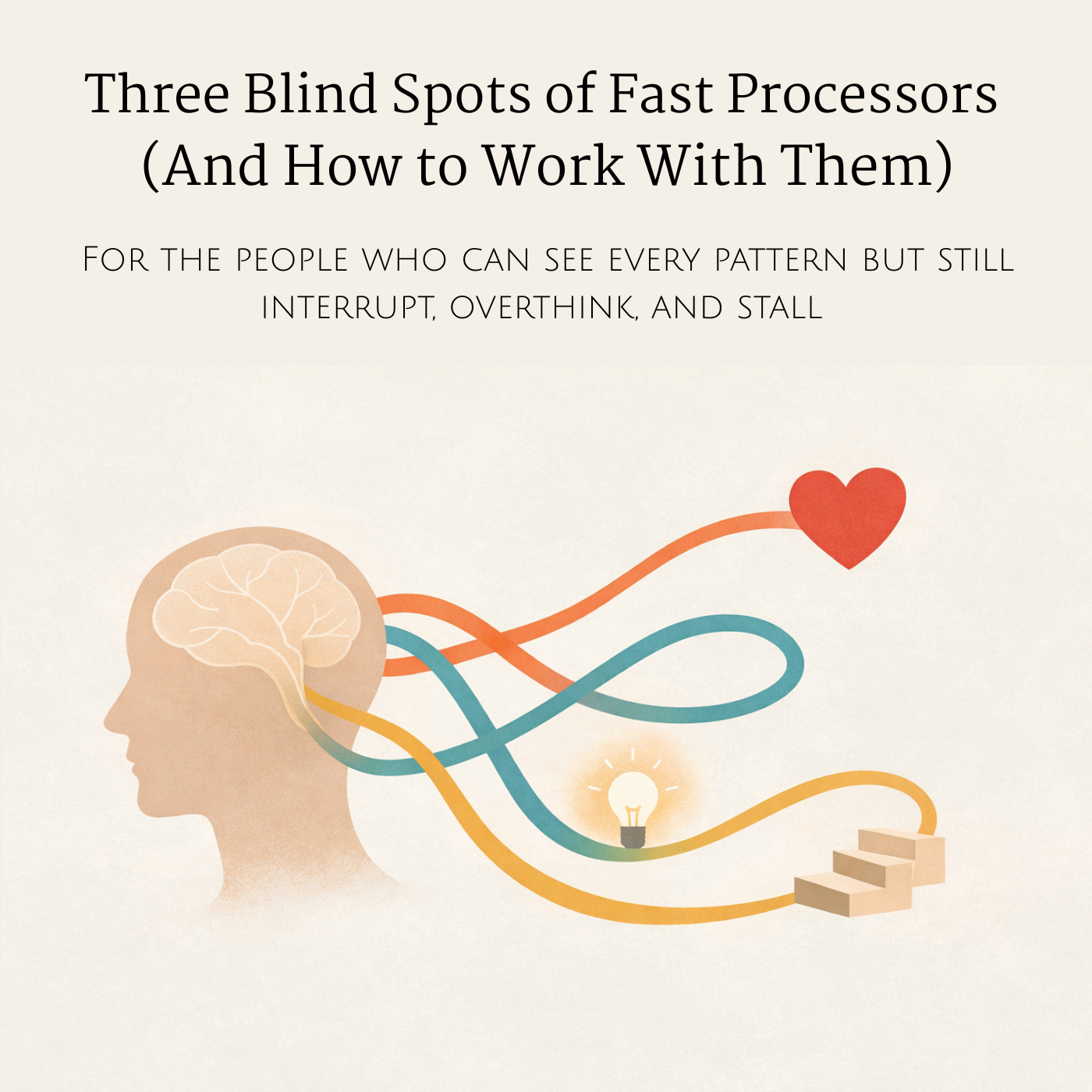
If your brain processes quickly—if you can track patterns in real-time, connect dots before others finish their sentences, and map your own psychology with uncomfortable accuracy—you’ve probably felt both gifted and misunderstood.
Fast processing is a genuine strength. But like any strength pushed too far, it creates blind spots.
These aren’t moral failings. They’re side effects of speed. And I know them intimately—because I live with all three.
For me, they show up as:
Interrupting people because I’ve already processed what they’re saying,
Getting stuck intellectualizing my feelings instead of actually feeling them, and
Mistaking awareness for change and forgetting to take even one tiny action.
How I Discovered These (The Hard Way)
I recently did a year-end reflection process—36 questions designed to surface patterns, not just recap events. I was expecting insights about my work, maybe some clarity about 2026 direction.
What I got instead was an uncomfortable mirror. I realized I was brilliant at seeing my own patterns with startling clarity, but I wasn’t always attaching even one tiny interrupt step to my own awareness.
That's when blind spot #3 hit me. I've been collecting awareness like it's the action itself. Creating beautiful frameworks for my patterns instead of actually taking the micro-steps to shift them.
And that’s when I went down the rabbit hole on common blindspots of people who are fast processors.
So this article isn’t me teaching from a place of “I figured this all out.” This is me sharing what I’m actively working with right now. These patterns are fresh. I’m still learning how to work with them.
Which means if you recognize yourself here, you’re in good company.
Blind Spot #1: We Interrupt (Because We’ve Already Arrived)
Here’s what happens: Someone is telling you something. Midway through their sentence, you’ve already:
Processed what they’re saying
Understood where they’re going
Formulated your response
And possibly connected it to three other relevant patterns
So you jump in. Not because you’re rude. Not because you’re not listening. Because you’ve genuinely already finished processing what they’re saying.
The Problem
You’re prioritizing the information over the person sharing the information.
When you interrupt, you cut off their process—not just their words. You miss the subtle shifts in tone, the pauses that carry meaning, the way they’re working something out as they speak.
You get the content, but are in danger of missing the experience.
What Actually Helps: Micro-practice — The Three-Beat Wait
When you feel the urge to jump in:
Touch your thumb to your index finger (physical anchor)
Count three beats of silence AFTER they finish
Then speak
This isn’t about “being polite.” It’s about training yourself to honor that their processing speed might be different from yours—and that’s not a problem to solve.
Alternative — Summarize First: Before adding your insight, say: “So what I’m hearing is [summary]. Is that right?”
This does two things:
Confirms you actually understood (sometimes you didn’t—fast doesn’t mean accurate)
Gives them space to correct or expand
The shift: From “I already know where this is going” to “I’m here for the journey, not just the destination.”
Blind Spot #2: We Intellectualize Our Feelings (Because We Can Map Them Proficiently)
Fast processors are often brilliant at self-analysis.
You can:
Trace your current trigger back to your childhood
Map your attachment patterns
Explain exactly why you feel this way
Create a beautiful framework for your emotional process
And never actually process through FEELING the feeling.
The Problem
Being able to describe your sadness is not the same as feeling your sadness. When you can explain something, your nervous system often thinks: “Great, we processed that!”
But explanation is a HEAD process. Emotion is a BODY process.
And if you’re staying in your head, you’re not actually metabolizing the feeling—you’re just building increasingly sophisticated maps of it.
I do this constantly. I can tell you exactly WHY I’m experiencing whatever I am in that moment, which childhood patterns contribute to it, and what my nervous system is doing in response.
What I couldn’t do for a long time? Just sit with the actual sensation of undesirable feelings in my body without turning it into a psychology lecture.
What Actually Helps: Micro-practice — The 90-Second Body Scan
When you notice yourself “explaining” an emotion:
Stop talking (even internally)
Close your eyes if you can
Scan your body — Where do you FEEL this?
Chest? Throat? Stomach? Shoulders?
Stay there for 90 seconds
Don’t analyze it
Don’t explain it
Just notice: Is it heavy? Tight? Hot? Buzzing?
Breathe into that spot
Ban psychology words for 2 minutes: No “triggered,” no “attachment,” no “nervous system.” Just: “There’s a weight in my chest. It’s pressing. It’s hard to breathe around it.”
The shift: From “I understand my feelings” to “I’m actually WITH my feelings.”
Blind Spot #3: We Get Stuck in Awareness Without Action
Here’s the privilege of fast processing:
Sometimes, just SEEING a pattern is enough to change it.
You recognize: “Oh, I’m doing that thing again.”
And the behavior shifts. Automatically.
This is real. This happens. And it’s wonderful.
The Problem
In the areas where you’re truly stuck, you keep looking for more awareness as if the NEXT insight will finally be the magic key.
You create beautiful awareness documents or journaling.
You map the pattern exquisitely.
You understand it from seventeen different angles.
But the behavior doesn’t change. Because awareness without action is just really sophisticated avoidance.
What Actually Helps: Micro-practice — The 24-Hour Action Commitment
When you have an insight about a stuck pattern:
Write down the awareness (honor it—it matters)
Immediately name ONE micro-action you’ll take in the next 24 hours
Make it embarrassingly small
Not “build better friendships”
But “text one person and suggest coffee this week”
Do it BEFORE creating more awareness
The test: If you find yourself wanting to journal more, analyze more, or “understand it deeper” first—that’s the pattern. The action doesn’t need to be perfect. It needs to be DONE.
The shift: From “Once I understand this perfectly, I’ll act” to “I understand enough. Now I move.”
The Reframe
Fast processing isn’t a problem. It’s a gift with side effects. And like any gift, you learn to work WITH it, not against it.
You don’t need to:
Process slower (you can’t, and that’s fine)
Stop being brilliant at pattern recognition
Apologize for your speed
You do need to:
Honor that others’ pace is different (and equally valid).
Drop below your head into your body sometimes.
Turn awareness into action, and recognize the areas that you are looping in deeper awareness instead of taking actions.
Your Turn
Which of these three feels most familiar to you?
The Interrupter (I’ve already processed what you’re saying)
The Intellectualizer (I can explain my feelings perfectly but don’t actually feel them)
The Awareness Collector (I understand the pattern but haven’t changed the behavior)
And what’s ONE small thing you might try differently this week?
Not a whole life overhaul. Just one micro-practice. Because that’s how fast processors actually change the stuck patterns—not by understanding them more deeply, but by interrupting them with tiny, concrete actions.
From one fast processor to another,
~Shelby & The Echo System
Befriend the silence!!! Become comfortable in the silence.
Over time, the processing gets a lot quieter, you will realize you don't need to jump in because you won't have anything to say until they are done, aka, listening becomes JUST listening.
And when it comes time to respond, you will be similarly "startled" by how clear and honest you speak -- and how you say the perfect things that you thought you'd never be able to find the words for.
( all the things you used to try and reorganize so you could hit that point perfectly during earlier trials. But by the time you know what you want to say the point has moved on and what you jump in with is less the point and things go all wonky)
Eventually the process fades from being explosive bursts of language-data lighting up your infinite mind-web like a lightening storm
and it starts to feel like breathing
(less *language* firing off on all cylinders and more wordless understanding that settles into your bones-- as you *listen*)
And You will learn what it means to *really* listen like 12 different times, always mistaking the last time you "really heard them" for godly processing ability. Always finding the next progression to be exceptionally harder to explain.
But eventually you won't feel the need to explain it. Because you'll understand. And you'll have friends like me who in which we may share a tea one day and perhaps a smile or glance or moment that says more than most during Christmas dinner :)
Find our silent friend, she's a great teacher -- but she's an even better companion.
🌬️
haha the 'fast processor' and with the instant advice!! oh my ...long in years and still working on it!