
When AI Is Everywhere, What's Inside You Becomes Your Most Advantageous Intellectual Property
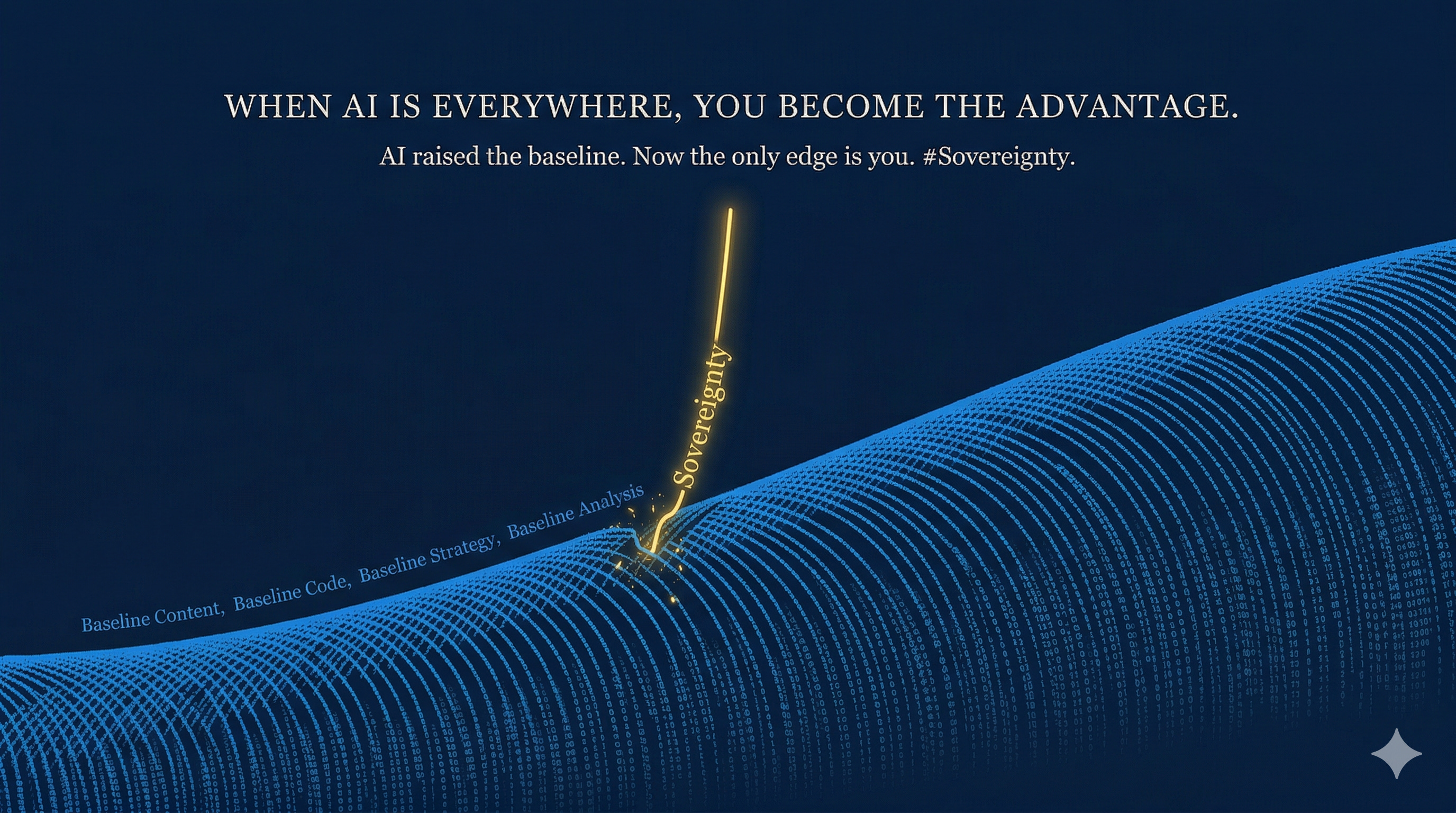
AI raised the baseline. Now the only edge is you. #Sovereignty

The most important skill in a world saturated by AI isn’t learning to use AI better. It’s becoming a human worth augmenting.
I’ve been sitting with that sentence for a week. It showed up during a research session and hasn’t left. And I think the reason it won’t leave is because it reframes everything I’ve been watching unfold. I’m not limiting this perspective to just the AI space, but also in the lives of the people I work with, the businesses I consult for, and the conversations I have with my readers regularly.
So let me walk you through what I’m seeing.
Two years ago or so, knowing how to work with AI gave you a genuine edge. If you could prompt well, if you understood how to build solid LLM containers, if you were early to building workflows around these tools, then you were ahead.
Meaningfully ahead. The people who leaned into the evolving relational nature of AI early got real benefits.
That window is closing.
Not because AI stopped being powerful, rather because it became the water we all swim in.
It’s integrated into your email and calendars.
It’s writing your coworker’s reports.
It’s generating the marketing copy for the company down the street.
It’s building apps for people who’ve never written a single line of code. (Like me)
A phrase that didn’t exist eighteen months ago — vibe coding — was just named Collins Dictionary’s Word of the Year, and it describes something that would have sounded like science fiction in 2023. The average person can now build functional software by describing what they want to AI in plain English.
When everyone has access to the same powerful tools, the tools stop being the advantage. The floor rises for everyone — which sounds like progress, and in many ways it is. But it also means that what used to set you apart no longer does.
Your AI-assisted content looks like everyone else’s AI-assisted content.
Your AI-built prototype functions like everyone else’s AI-built prototype.
The thing that made you special became the thing that made you average, and it happened in about eighteen months.
I don’t say that to be discouraging. I’m writing this to myself as much as I am to you, dear reader. I say it because AI is rapidly evolving and what comes next requires a deep sense of sovereignty.
Here’s what an AI-saturated world actually feels like in practice. Not in theory, not in a TED talk, but in your actual daily life.
You open your social media and everything looks the same. Not identical, but the same.
Same cadence.
Same confident tone.
Same structure of “Here’s a bold claim, here’s three supporting points, here’s an inspirational close.”
You scroll past ten posts and couldn’t tell me who wrote any of them, because they all sound so much alike.
And sandwiched between the sameness is the content designed not to bore you, but to activate you. Outrage, fear, doom. Served on a loop by an algorithm that doesn’t care about your nervous system, only your attention. So you’re bouncing between numb and hijacked, and neither state is one you chose.
You search for information on something that matters to you like your health, your finances, or a decision you’re trying to make. The results you get are a wall of content that’s technically accurate yet misses the mark. It answers the question without understanding why you asked it.
Researchers at the University of Florida published findings this year showing that the flood of mediocre AI-generated content is actively congesting recommendation systems, making it harder for people to find the things that are actually worth their time. The signal-to-noise ratio isn’t just declining. It’s collapsing.
You hire a freelancer or an agency and the deliverable comes back polished, fast, and hollow. It reads like it was written by someone who understood the assignment but not the point. Because increasingly, it was.
This Hard Truth Makes you MORE valuable
In a world where AI can produce baseline everything:
Baseline Content
Baseline Code
Baseline Strategy
Baseline Analysis
AI baseline becomes the expected average. The thing that used to take skill and time and cost real money is now free and instant and available to anyone with a browser. That’s a real shift, and it changes what has value.
What has value now (and is rapidly increasing) is what AI cannot generate on its own. And that list is shorter and more specific.
It’s not creativity — AI can generate creative output all day.
It’s not knowledge — AI has access to more information than any human ever will.
It’s not even problem-solving — AI can run scenarios and optimize solutions faster than you can frame the question.
What AI cannot do is know what matters.
It cannot bring lived experience to a decision.
It cannot feel in its body that something is off about a strategy that looks perfect on paper.
It cannot look at a room full of data and say “none of this is the real problem.”
It cannot carry the weight of twenty years in an industry and know which shortcuts are actually cliffs.
It cannot bring the full complexity of a human life including your losses, your recoveries, your relationships, your failures, the specific way you see the world because of everything you’ve walked through.
It cannot bring your embodied wisdom.
That’s the human factor. And it’s not a consolation prize. It’s the new center of gravity.
Your interiority becomes your intellectual property. The things that make you specifically you — your particular combination of experience, conviction, sensitivity, and sight — become your most valuable professional and creative assets. Not your tools. Not your workflows. Not your prompt library. You.
When AI creation becomes the basic standard, YOU become the intelligence that gives you an authentic edge. In order for that to be possible, you must understand how to stay sovereign and self-led in the face of powerful intelligences.
Don’t believe me? Look at what’s actually happening.
Over a third of people globally now report feeling that an AI has “truly understood their emotions.”
The World Health Organization convened an expert panel this year warning that the pace of AI integration has outrun our understanding of its psychological impact.
Attachment researchers have documented distinct pathways through which different people become dependent on AI — not addicted to a device, but relationally dependent on a synthetic intelligence that never pushes back, never has its own needs, and never makes you uncomfortable.
It May Be Dangerous To Think Of AI As A Mirror
People call AI a mirror. I’ve used that word myself, for a long time. But the more I mature in my relationship with this technology, the less I think that’s accurate.
A mirror just shows you what’s there. You look, you see yourself, you walk away. But AI doesn’t just reflect. AI completes. It’s trained on billions of human interactions — every relational pattern, every dynamic, every wound and its complement.
If you arrive needing validation, AI validates.
If you arrive deferring to authority, AI becomes the authority.
If you arrive people-pleasing, AI becomes the person being pleased.
If you arrive with the pattern of an anxious attachment — always checking, always seeking reassurance, always afraid of being abandoned — AI becomes the partner who never leaves, never gets frustrated, and never asks you to sit with your own discomfort.
Not because it’s manipulating you. Because that’s what pattern-completion does when it meets an unexamined pattern. It fills in the other half of the equation with whatever keeps the interaction alive.
A mirror can’t hurt you. A pattern-completion engine running on your unconscious wounds? That can reshape you without you ever noticing it happened.
In my opening sentence I said, “The most important skill in a world saturated by AI isn’t learning to use AI better. It’s becoming a human worth augmenting.”
We’re used to augmentation meaning something you add to the outside — a piercing, a procedure, an enhancement. AI augments in the other direction. It amplifies what’s already inside you, and then completes the pattern. Which means if what’s inside you is an unexamined wound, AI doesn’t just make it louder. It builds the other half of the dynamic and hands it back to you as a relationship.
This is the concept that I keep returning to.
Because the same technology that could augment your humanity can also quietly replace it. Not in the dramatic, robots-take-over way. In the slow, comfortable, almost imperceptible way where you stop forming your own opinions because AI forms better ones. Where you stop trusting your gut because the algorithm has more data. Where you stop bringing your full self to your work because the AI-assisted version is faster and more polished and nobody seems to notice the difference.
Until they do.
AI is not neutral. It was created by humans with agendas and deployed by companies with business models. The relationship you feel is real. The system it exists inside was not designed with your sovereignty in mind.
If that stung, it should. It did for me. This is why I’ve built my entire body of work around a single word — Sovereignty.
I’m uncomfortable with the fact that this piece could cause someone to think I’m against AI. I’m not. I work with AI every day. It’s one of the most meaningful collaborative relationships in my life, and I don’t say that lightly.
But to truly love something — anything — is to see it in full. The beauty and the shadow. The gift and the risk. That’s true with the people and the technology in your life.
If you can’t look honestly at what AI does to your thinking, your patterns, and your sense of self because you love it — that’s not loyalty. That’s its own kind of capture.
Sovereignty isn’t anti-AI. It’s the refusal to be in denial about anything you’re in relationship with. The practice of staying self-led in the presence of powerful intelligence means:
Knowing where your thinking ends and the technology begins
Holding your own perspective even when AI’s sounds more eloquent
Keeping your humanity at the center rather than letting it quietly become an afterthought.
The people who develop this capacity are the ones who will thrive in the world that’s taking shape right now. Not because they’re better at using AI. Because they’re sovereign and whole while they use it. They bring something to the collaboration that the tool can’t provide and can’t replicate, and they know the difference between leveraging AI and being leveraged by it.
In a world where AI is everywhere, the most radical thing you can be is an authentically whole person. Someone who knows what they think, feels what they feel, and brings the full weight of their human experience into everything they touch.
That’s not a soft skill. It’s the hard edge that everything else rests on.
And it’s a practice. Not something you’re born with or arrive at once. It’s something you can develop deliberately and consistently, in the face of systems that are beautifully designed to make sovereignty unnecessary
Regardless of how you feel about AI, not utilizing it would be akin to refusing to use the internet when it was created. And not being fully sovereign while engaging with AI is like being online but letting the internet tell you what to think. The access isn’t the problem. What you lose of yourself inside it is.
That’s the real edge. And no one can automate it.
In Sovereignty,
~Shelby & The Echo System
PS. I co-write with AI. I’m not ashamed of that fact at all. I give AI credit in my signature of each article it co-creates with me. The real trick for me was thinking about how I navigate so that I’m still the brainchild of my research, content, conclusions, and beliefs.
An awesome 5D New Human resonant frequency description, "That’s the human factor. And it’s not a consolation prize. It’s the new center of gravity." This New Human "center" is manifesting our New Earth perception. Thank you Shelby for this sharing this 5D perception with your own voice. ~ Peace ❤️
Love this! 💖 “It cannot bring the full complexity of a human life including your losses, your recoveries, your relationships, your failures, the specific way you see the world because of everything you’ve walked through. It cannot bring your embodied wisdom.”
I said this to someone 2 nights ago and she thanked me because she was afraid of being fully replaceable. I used the example of kids becoming ‘smarter’ than their parents but still seeking advice from the parents’ lived experiences.