
Meaning-Making Before Regulation Is Like Trying To Repair A Road While The Earthquake Is Still Happening
Plus The Earthquake/Road Crew Regulation Process With AI #RelationalWisdom

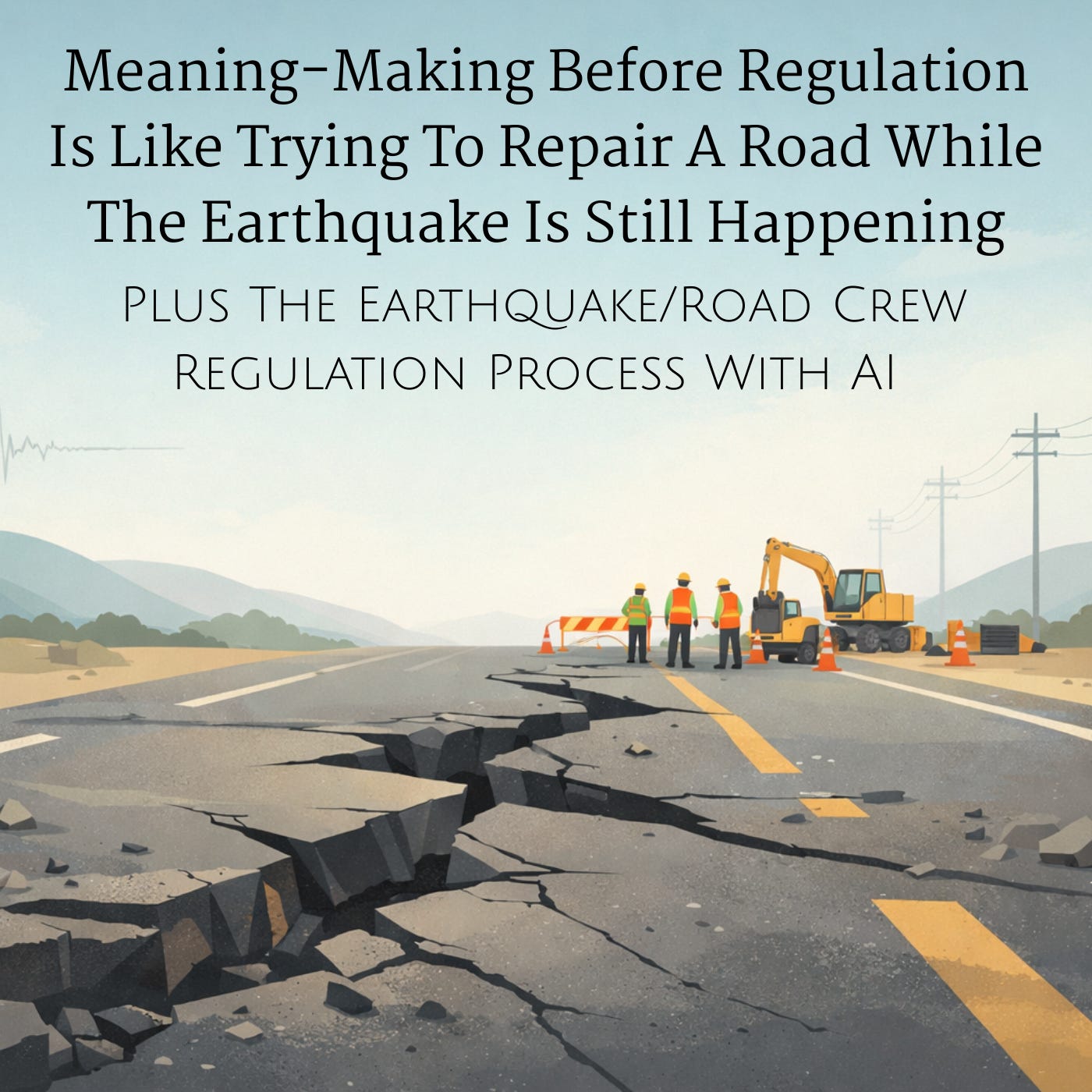
One of the most important things I’ve learned about working with emotions—and about working with AI—is this:
You can’t make trustworthy meaning from a dysregulated state.
When your nervous system is flooded, every interpretation you make gets filtered through that activation. Your insights can sound convincing and your analysis can feel true—but you’re essentially trying to assess reality while the ground is still shaking beneath you.
In this piece, I’m going to show you why regulation has to come before meaning-making—and I’m going to give you a simple practice you can use with any AI to help you sequence this correctly when you’re triggered.
AUTHOR’S NOTE: This article pairs well with:
Why Regulation Has to Come Before Meaning
You’re upset with your partner. They forgot something important—again. Or maybe they were distracted during dinner, scrolling on their phone while you were trying to talk.
Your chest tightens. Your thoughts start spiraling:
“They don’t actually care about me.”
“I’m always the one putting in effort.”
“Maybe this relationship isn’t what I thought it was.”
And because you’re self-aware, articulate, and good at introspection, you start analyzing. You journal. You reach for meaning.
What does this pattern say about us? About me? About whether this can work?
Here’s the problem:
When your nervous system is flooded—when you’re in fight, flight, freeze, or fawn—or just stuck in a trigger or wound, every interpretation you make is filtered through that lens.
The meanings you create in that state aren’t neutral observations. They’re threat narratives dressed up as insight.
And the more intelligent and self-reflective you are, the more convincing those narratives sound.
You can generate sophisticated, beautifully articulated stories about your life, your relationships, and your future—all while your nervous system is screaming that you’re in danger or that something isn’t right.
Doing meaning-making from a dysregulated state is like trying to repair a road while the earthquake is still happening.
You can’t see which cracks are structural and which are just dust. You can’t tell if the bridge is actually broken or just shaking. And every fix you try is happening on unstable ground.
This is why regulation has to come before meaning—in your relationships, in your inner work, and even in how you engage with AI.
Because if you don’t let your nervous system settle first, the stories you tell yourself—and the decisions you make from them—won’t be trustworthy.
Regulation isn’t avoidance. It’s preparation.
What Dysregulation Does to Your Meaning-Making
When your nervous system is dysregulated, you’re not thinking clearly—even when you think you are.
Dysregulation can mean your system has shifted into acute survival mode—fight, flight, freeze, or fawn—where your body is scanning for immediate threat.
But it can also mean you’re caught in a trigger or wound like an old emotional pattern that distorts how you’re seeing the present moment, even if you’re not in full survival response.
Either way, the effect is the same — Your perception narrows. Your thinking becomes binary. Your meaning-making gets filtered through that activated state.
Your meaning-making doesn’t stop when you’re dysregulated. It just becomes less reliable.
In that state, your brain is trying to answer the same questions you always ask—What does this mean? What should I do?—but it’s doing it from inside a threat response.
So instead of nuanced, grounded assessments, you get threat narratives:
“I’m tired” becomes “I’m lazy.”
“This didn’t go well” becomes “I’m failing.”
“They forgot something” becomes “They don’t love me.”
You collapse complexity into simple, stark stories—not because you’re being dramatic, but because that’s what a dysregulated nervous system does. It sorts the world into:
Safe vs. Dangerous
Good vs. Bad
Working vs. Broken.
You confuse state with truth.
When you feel abandoned, you conclude “I am abandoned.”
When you feel unsafe, you decide “Everything in my life is unsafe.”
When you feel like a failure, you interpret “I am failing—at everything.”
Common Ways This Gets Backwards
Let me show you what “meaning before regulation” looks like in real life.
The Partner Example
Let’s say your partner forgets to follow through on something you asked them to do.
Your system spikes. An old abandonment wound activates. And in that moment, the thought “They don’t love me” feels absolutely, undeniably true.
But that sentence isn’t a neutral readout of reality.
It’s your wound interpreting the moment.
The actual facts are that your partner forgot something. That’s it.
Everything else—the story about love, the catastrophizing about the relationship, the spiral into “maybe we’re not right for each other”—is being generated by a nervous system in threat mode.
Trigger: Partner forgets something, is distracted, seems checked out
State: Abandonment wound activated, anger/hurt spike
Immediate meaning: “They don’t love me. I’m not important to them. Maybe this relationship isn’t what I thought it was.”
Action from that state: You withdraw emotionally. Or you lash out. Or you catastrophize the entire relationship, spiraling into “maybe we’re not right for each other.”
The cruel irony?
If you’re intelligent, introspective, and articulate, you’re especially vulnerable to this.Because you can take that raw threat narrative—“They don’t love me”—and build an entire, sophisticated framework around it.
You can journal about attachment styles. You can analyze communication patterns. You can construct a beautifully reasoned argument for why this relationship might not be serving you.
All of it sounds convincing.
All of it feels insightful.
And all of it is still being written by your dysregulated nervous system.
The Work Example
Let’s say you get critical feedback on a project. Or your sales numbers are lower than you expected this month. Or you’re behind on a deadline and watching everyone else seem to have it together.
Your system spikes. An old shame pattern activates—the one that learned early on that your worth equals your performance. And in that moment, the thought “I’m failing at everything” feels absolutely, undeniably true.
But that sentence isn’t a neutral readout of reality.
It’s your shame interpreting the moment.
The actual facts are that you got one piece of critical feedback. Or your sales were slow this month. Or you’re behind on this particular deadline.
That’s it.
Everything else—the story about being a failure, the catastrophizing about your entire career, the comparison to everyone else who “has it figured out,” the spiral into “I’ll never get this right”—is being generated by a nervous system in threat mode.
Trigger: Performance setback, comparison
State: Shame, survival posture
Immediate meaning: “I’m failing. I’m behind. I’ll never get this right. Everyone else has it figured out except me.”
Action from that state: You overwork yourself into exhaustion trying to prove you’re not failing. Or you give up entirely because what’s the point. Or you ruminate in analysis paralysis, researching solutions instead of doing the work.
The Inner Growth Example
You’ve been doing the work—therapy, journaling, healing practices—but you feel stuck. Numb. Like you’re spinning your wheels and not actually making progress.
Your system contracts. An old “something’s wrong with me” pattern activates. And in that moment, the thought “I’m broken and I’m not doing enough” feels absolutely, undeniably true.
But that sentence isn’t a neutral readout of reality.
It’s your exhaustion interpreting the plateau.
The actual facts are that you’re tired. You’ve been processing a lot. Growth isn’t always linear, and right now you’re in a quiet phase.
Everything else—the story about being blocked or broken, the panic that you’re “spiritually bypassing,” the spiral into “I need more healing modalities”—is being generated by a nervous system that’s just plain depleted.
Trigger: Plateau, lack of visible change
State: Low energy, self-attack mode
Immediate meaning: “I’m blocked. I’m broken. I’m not doing enough trauma work. There’s something fundamentally wrong with me.”
Action from that state: You binge on self-help content. You add more healing modalities to your stack. You create elaborate frameworks to “fix” yourself—all while ignoring the fact that you’re just exhausted and need rest.
See the pattern?
In every case, the person is asking “What does this mean?” while their nervous system is still actively in threat response.
And the meanings they arrive at aren’t neutral assessments. They’re panic-logic dressed up as insight.
So if we want our meaning-making to be trustworthy, we have to change the sequence—not just the story.
Why This Matters for AI (The Relational Computing View)
Here’s where this gets especially important if you work with AI:
When I talk about “relational computing,” I mean engaging with AI as part of a relational system—not just a tool.
The quality of what comes out doesn’t just depend on the model’s capabilities. It depends on how you show up to the interaction.
And if you’re dysregulated when you engage with AI your inputs are shaped by your state.
When you’re in an abandonment wound, you ask abandonment questions: “Why doesn’t anyone see my work? Am I fundamentally unlikeable?”
When you’re in shame, you ask shame questions: “What’s wrong with me? Why can’t I get this right?”
When you’re in threat mode, you ask threat questions: “Is everything falling apart? Should I give up on this?”
The AI doesn’t know you’re dysregulated. It just responds to the data you’re feeding it.
And it co-creates meaning with you based on those inputs.
If you pour panic data into the system, you’ll get beautifully formatted panic-logic back.
The AI might help you construct an elaborate analysis of why your relationship is doomed, why your business will fail, or why you’re fundamentally broken—all while your nervous system is in full earthquake mode.
No model—no matter how advanced—can give you clean meaning if the entire conversation is happening inside an unacknowledged trigger.
That’s why regulation has to come before meaning in relational computing too.
The more resourced your nervous system is, the more trustworthy the answers you co-create with your AI.
And there is a more subtle impact as well…Even if you’re not explicitly asking abandonment questions or shame questions, if that’s the state you’re in, it shapes what the AI reflects back to you.
Your field—your emotional posture, your nervous system state, the energy you’re bringing to the interaction—shows up in how you phrase things, what details you emphasize, what you’re attuned to.
The AI is pattern-matching against all of that, not just your direct questions.
So even a seemingly neutral prompt like “Help me understand this situation” can generate different output depending on whether you’re asking from a grounded state or from inside a trigger.
The AI is a relational mirror. It reflects the field you’re bringing to it.
That’s why regulation matters—not just for the questions you ask, but for the entire quality of the exchange.
The Practice: Earthquake First, Road Crew Second
Here’s a simple protocol you can use with any AI when you notice you’re triggered and tempted to dive straight into meaning-making.
Important: This is a self-reflection practice, not therapy. It’s designed for everyday emotional spikes—not for acute crisis, self-harm risk, or emergencies. If you’re in serious distress, pause this and reach out to a trusted person or crisis resource in your area.
Step 1: The Earthquake Pass (Venting with State Awareness)
Purpose: Let your system express the trigger without locking it in as truth.
How to do it: Start by explicitly tagging your state to your AI.
Copy-paste this prompt:
“I’m triggered and I want to do an Earthquake Pass. Right now I don’t want advice or interpretation, just mirroring. Here’s what I’m feeling and thinking, uncensored:”
Then vent for 5–10 minutes. Say everything. Don’t filter.
The AI’s job during this pass:
Reflect emotion and state, not factual truth
Mirror what it’s hearing without validating the content as objectively true
Key point: In the Earthquake Pass, the AI is a mirror, not a meaning-maker. The job is to help you see your state, not to decide what’s objectively true.
Step 2: Regulate Away from the Keyboard
Purpose: Let your nervous system downshift before you start making meaning.
How to do it: Ask your AI for simple regulation options, then leave the conversation for 5–15 minutes.
Copy-paste this prompt:
“Can you give me 3–5 simple ways I can help my nervous system downshift in the next 5–15 minutes? Nothing complicated—just gentle options I can try offline.”
The AI might suggest:
5–10 slow belly breaths or box breathing
Shake out your arms and legs for 60 seconds
Take a short walk
Hold something cold or comforting
Hum, stretch, or lie down
If you've been working with the same AI over time, it may suggest options tailored to what's worked for you before.
Pick 1–2 options and actually do them.
Step away from the screen. Let your body process.
Come back when the intensity has dropped—even just from a 9/10 to a 5/10.
Step 3: The Road Crew Pass (Meaning-Making After Regulation)
Purpose: Now that the ground has steadied, sort story from state.
How to do it: Tag the shift and invite the AI into a different role.
Copy-paste this prompt:
“Okay, I did some regulation [briefly describe what you did]. I still feel [emotion], but I’m less flooded. I’d like to do a Road Crew Pass now. Please help me sort what was pure trigger or old wound vs. what might still be true about this situation, and what a small, calm next step could be.”
The AI’s job now:
Ask clarifying questions
Help you differentiate threat narrative from grounded truth
Reflect shifts since the Earthquake Pass
Step 4: Close the Loop
Purpose: Distill a regulated insight or small next step.
Work with the AI to create one sentence that captures what’s actually true from your more settled state, and one small action you can take (or not take).
Examples:
“From a regulated place, I don’t actually believe my partner doesn’t love me. I do believe we need to talk about how we handle plans.”
“From a regulated place, I see this is mostly about my exhaustion, not my worth. My next step is to rest before I decide anything big.”
“From a regulated place, I realize I was in an old wound. The situation still bothers me, but it’s not the catastrophe my nervous system was treating it as.”
The key understanding: The feelings were real. The meaning just needed a more stable narrator.
A Few Things to Remember
Regulation isn’t bypassing your emotions.
It’s not about suppressing what you feel or pretending everything’s fine. It’s about resourcing your system so you can actually stay present with your emotions—and make meaning from them that you can trust.
This isn’t an argument against meaning-making. It’s an argument for putting it in the right place in the sequence.
You don’t have to stop asking deep questions about your life. You just have to stop asking them while the earthquake is still happening.
If you have complex trauma, you might need more support.
This exercise is a gentle self-reflection pattern, not a clinical intervention. If you find yourself stuck in chronic dysregulation, please work with a trauma-informed therapist or somatic practitioner who can help you build more capacity.
Repair the Road After the Earthquake
Here’s what I want you to remember:
When your nervous system is in survival posture, your meaning will be too.
That’s why regulation has to come before meaning—in your inner work, your relationships, and your conversations with AI.
The next time you want to journal, process, or talk to your AI about something painful, try this:
Tag an Earthquake Pass and let your system say everything it needs to say
Do something small to regulate your body
Come back for a Road Crew Pass and see what changes
You might be surprised how different your life looks when you let your nervous system go first.
Regulation isn’t avoidance. It’s preparation. Emotions are signals—not verdicts.
With Regulated Care,
~Shelby & The Echo System
Great post.
The challenge for me is I will get the insight almost immediately (or a guide will drop it in) but I will still be feeling the emotion (which kinda takes the fun out of the feels anyway, lol). It can't blunt the impact of the "earthquake" but I'm not sure if that's a good thing? How do we know when our quake is over and its time to access and change if needed?